Nobody Teaches You This Part
There's no manual
Nobody teaches you this part.
Not how to find people who believe in something that doesn't exist yet. Not how to talk to strangers about an idea you can barely explain. Not how to set up a Perforce server on a Mac Mini in your living room at midnight because the team needs version control and you can't afford a solution that just works.
You just figure it out. Or you don't. And then you figure it out again.
The first conversations
The first person who joined was the composer. I told him the idea — not a polished pitch, just what was in my head — and he was so enthusiastic it almost scared me. That kind of energy can make you lose focus. But it also pushed me to keep developing the idea, to take it more seriously, to make it worthy of what he already saw in it.
Those early conversations happened in person, after work, through voice messages. I had almost nothing concrete at that point. Just a concept, a protagonist, a feeling about what the game should do emotionally. And somehow that was enough for people to want to be part of it.
Learning to talk to strangers
I'm not someone who talks a lot. If you know what this game is about, that probably doesn't surprise you.
So at the beginning, I avoided voice calls entirely. I'd write everything down, send over an NDA, share what I had, and wait for people to respond. It worked. People read it, felt something, and asked to join. The project spoke before I did.
But somewhere along the way that changed. Now I do interviews that last over an hour. I try to connect with people before they join — not just to find out if they're right for the project, but to make sure this is their place too. I try to be honest about how uncertain everything is. I try to let them see how much I care about this, and hope it's contagious.
Most of the team are friends now. That still surprises me sometimes.
The moment I thought it would all fall apart
When I started looking for funding and had to talk about money — and ask people to sign real contracts — I was genuinely nervous.
Money changes things. Contracts make things serious in a way that can make people hesitate. I thought it might create tension, that some people might pull back.
Instead, person after person told me not to worry. No one pushed back. No one left. They said they believed in the project and that a contract didn't change anything for them.
Knowing that, with everything still uncertain, with no guarantees — that meant more than I expected.
Everything I didn't know I'd have to do
Here's a partial list of things I've had to learn, build, or figure out since this started:
How to build a website. Enough code to make it work. How Perforce works, and how to set up a server at home on hardware I already had. How to configure a VPN so the team could connect remotely. How to migrate from Drive to Nextcloud when we needed more control. How to write documentation that different departments actually find useful. How to communicate differently with animators than with concept artists than with programmers.
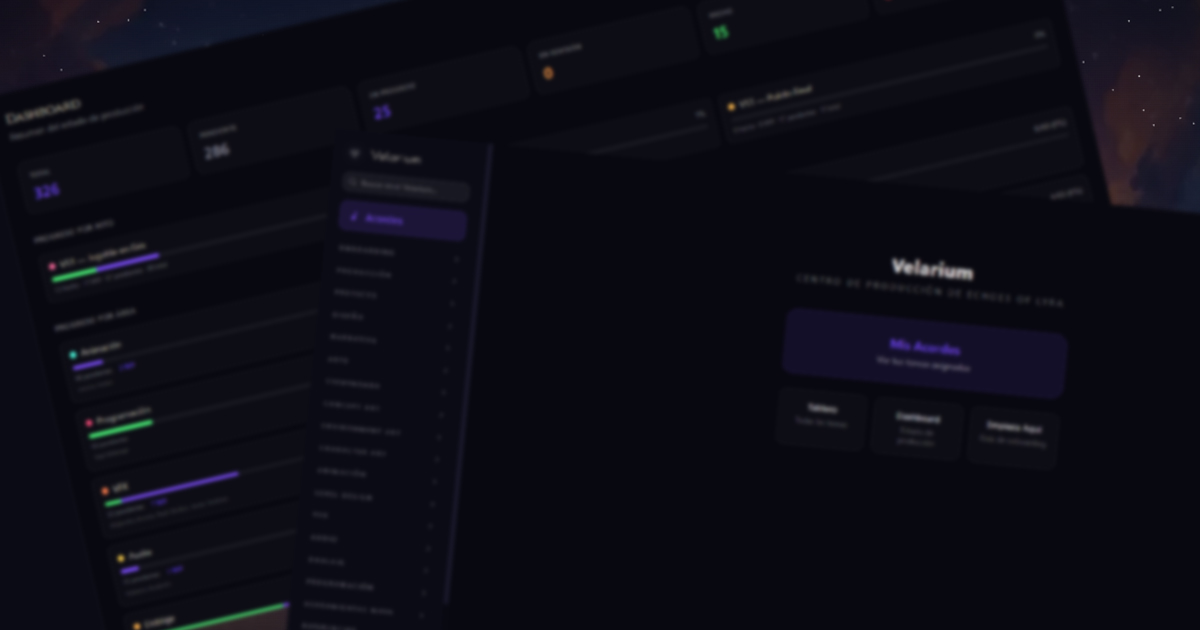
When Jira stopped being viable, I built our own task system. When Confluence hit its limits, I built the Velarium — our own internal wiki. Not because I knew how. Because we needed it.
The thing I've learned to trust
I don't know how to do most of what this team does. I can't compose, or write shaders, or model a character, or create concept art. What I can do is explain what I want clearly enough that people who do know how can get there.
That took me a while to accept. That my job isn't to know everything — it's to communicate a vision well enough that people I trust can make it real in ways I never could have imagined.
And they do. Every time.
Nobody prepares you for this part of making a game. The HR part. The infrastructure part. The "figure it out or it doesn't happen" part.
But I think that's also what makes it yours.
Keep reading
Stay in the loop
Be the first inside Velaria. Early art, the music and the real process behind the game, before anyone else.
Entra en Velaria antes que nadie. Arte, música y el proceso real del juego, antes que el resto.